Jozi and Cape Town are home to Marble Hospitality eateries, where Chef David Higgs has created a new formula on the luxe food scene. Liezl Vermeulen sits down with him to understand the success of his ever-growing business.
The last time I saw David Higgs, I was sitting in his winelands restaurant for my very first experience with fine dining. Memories of the food are fuzzy now, but I have a distinct recollection of extremely attentive service (to the point where I considered that they could read my mind). Fifteen years on, I remember the soft, double-lined table tops and the famous chef that came to talk to us at the table. Those highlights are crystal clear to this day.
A restaurant is more complex than the food on the plate – it’s the entire experience of the meal. But an elevated dining experience doesn’t mean food needs to be complicated.
View this post on Instagram
The journey to the Marble top
In 2007, Rust en Vrede was a culmination of David’s experience: from his first year-long gig cooking breakfast at Protea Hotel to working in industrial catering (where he got an understanding of managing numbers), then owning his own cookery school and restaurant. All this led him to the Stellenbosch vineyards, where he could build something form the ground up.
In this cellar, Chef David created an open kitchen, where he could engage with both front and back of house – now his signature way of working. “It was the first time I realised how important that was, to get a feel for the room.” He could gauge his customer, pairing them with the right waiter. Now he was not only conducting the kitchen, but orchestrating the entire set-up. “It was an incredible experience because then I got to really understand the whole package of hospitality.” Critics and diners agreed that it was an incredible experience, with the winning formula landing him a hat-trick in 2010 at the Eat Out Awards: Restaurant of the Year, Chef of the Year and the coveted Service Excellence Award.
It could’ve been the pinnacle of his career. He could have easily gone “copy-paste” and fine-tuned his formula for success on the wine farm next door, as many do. But he simply couldn’t sit still. I get the sense that he’s always moving, many irons in the fire. Even while talking to me, he’s simultaneously juggling business calls and moving between two of their many business locations.
Getting to know Jozi
“People thought I’d lost my mind,” Chef David recalls. He packed up and moved to Johannesburg, swapping his 40-seater fine dining restaurant for the Radisson Hotel, where after some work, they served 150 to 200 guests a night.
“Not for one minute did I think that I could go into a new space, a new territory, a new province and just sort of take over the world,” he says. “You’ve got to be very careful with arrogance, and ignorance to a certain extent, in our industry. The first thing I learnt was that no one even knew who David Higgs was.”
He had stepped out of the Cape Town bubble and got in touch with the Joburg crowd – one that didn’t care much for fine dining but came for a good time and good food.
Always-moving David soon went to the Saxon Hotel, which featured an everyday eatery (Qunu) and 500, a small fine dining restaurant. The latter would go on to rank second in the same Top 10 Eat Out Awards – something David quickly moves past to share the lessons he’s learnt instead.
“People started ordering steak and chips from downstairs, Qunu restaurant, but wanted to eat it upstairs in the fine dining restaurant. These were some of South Africa’s richest men. It was clear that people wanted to sit in the fancy restaurant, but they didn’t want fancy, fine dining food.”
Give the people what they crave
Gary Kyriacou got in touch with David about a grill he wanted to import, and it was obvious their hospitality style aligned. And so, Marble was born. Together the duo had a clear goal: serving food that people understood and could recognise at a glance. It was the simplicity of a quality steak, sliced and served with sides, instead of fancy drawings using reincarnated ingredients that you would typically find on a fine dining plate. “A lot of finesse and care is taken in the preparation of the food and serving of these dishes. That’s really been the ethos of our restaurant, to show value for money. It is expensive, but we give an experience.”
David brought his signature open-kitchen style, creating the heart of the restaurant with a grand wood-fired grill imported from Michigan in the USA, pumping flame and flavour into the kitchen and onto plates.
That same grill has now been burning for 10 years. “I mean, it’s just a really beautiful chunk of steel,” David says, as he explains the intricacies and quality of the craftsmanship behind it. Previously, they used sekelbos wood but this proved too hot. They’ve tinkered with the process, getting the heat just right by using a combination of wattle charcoal as well as sekelbos wood.
The Marble blueprint
Marble restaurant now has two branches – the original in Rosebank and in Cape Town’s V&A Waterfront. “The first thing you’ll find in all the Marble restaurants is that warm welcome from our hostesses,” says David. “Secondly, [there are] these fires that are burning, which always just calms people down. It’s a sense of gathering, you know.” Fire has always had the ability to draw us in, leaving us standing around it. It’s something South Africans know particularly well. And finally, there is their extensive bar that’s there to unwind at before or after your meal.”
We stop to talk about Marble Cape Town, where I’ve recently found myself. Situated in a heritage building next to the harbour, you take the exclusive elevator to the second floor that only houses the restaurant.
“You’re immediately lifted out of the Waterfront, out of the noise and chaos, and walk into this real sort of calm,” David explains. “The first thing that strikes you when you walk out of the lift is the smell. If the wind is blowing in the right direction, you get that sweet mussel smell from the ocean, and for me, that’s everything. (If the wind doesn’t blow you off the balcony, then you’re lucky you’re having a good day in Cape Town.) And then, obviously, Table Mountain. I mean, it’s hard to ignore that kind of thing. So immediately your senses take you to another level.”
View this post on Instagram
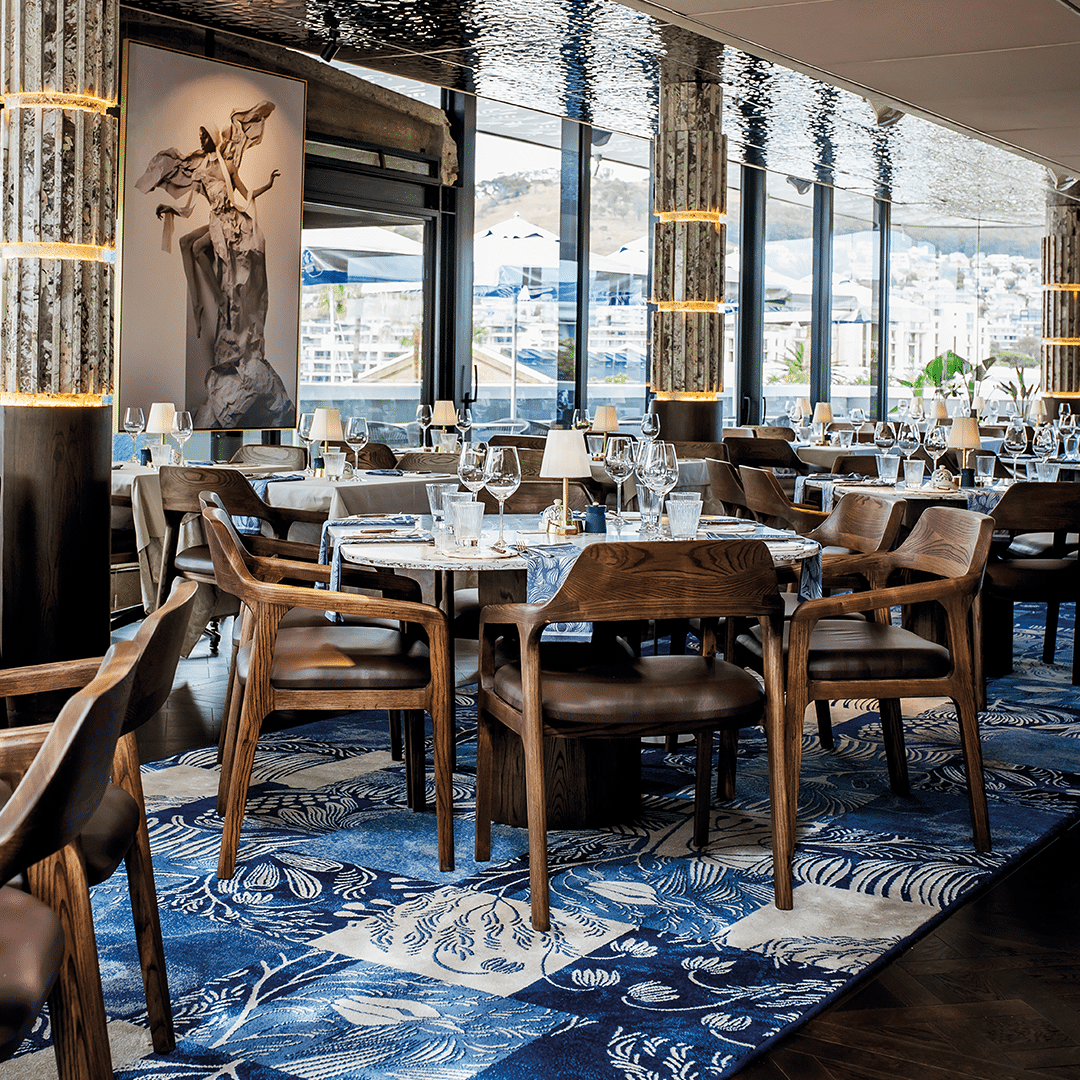
As you walk through the door, you’re greeted with the luxury of space. There’s contrast in the grandeur of space and the warmth of the welcome. The interior design echoes the blue and white of the ocean surrounds – it’s fancy but not overbearing – and the fire is mulling in the centre. The silver roof with a dappled, uneven surface mimics the vast ocean, refracting light as you walk to your seat.
“That has really been a very big part of what we do at the restaurant; creating a juxtaposition of real comfort in class. People want to sit in this beautiful environment, but they want the normality and the comfort, the recognition, the nostalgia of what they eat as normal people.”
On the menu
There’s a juxtaposition to the menu too: a love for local next to what can be described as international exposure. When asked why he includes products from the USA at all, the answer is summed up simply: consistent quality.
Whether it is Jersey (which saw tremendous popularity at Marble), Angus or Wagyu, it’s been a struggle to get consistent quality in SA. (A restaurant can’t exactly get refunds if a customer sends back a tough steak.)
Of course, it’s not the financial implication David mentions. For the restaurateur, it’s the high standard that he constantly manages. Whether it’s at one of Marble Hospitality’s four restaurants, their unique retail offering (Pantry) or at their events (such as The Luxurious Marble Circus), your steak or seafood needs to be the same quality. That’s why they expose the local market to the international offering. But importantly, it is never at the expense of the local variety available. “We still prefer the South African meat,” David asserts. “It just has a better flavour, it’s more meaty.”
Moving past the main course and the open-fire food, we get to what I personally find particularly special: their Cape Town cheese trolley. David partnered with Karen Dudley, an icon in Cape Malay cooking who is always experimenting with the fruit, vegetables and flavours of our local spice route. She’s gone to procure some preserves from Woodstock, Bo-Kaap and Gatesville, getting sour fig jam from aunties that have been making it for a lifetime. The rest she dreams up, like her guava and gochujang preserve. “It’s almost a show-off of condiments rather than the cheese,” says David. “I mean, Maketaan… When last have you heard that word, you know? That, for me, is real nostalgia. That’s really how I grew up, with a very VERY Afrikaans family.”
View this post on Instagram
While the entire offering of Marble Hospitality, as well as the meticulous and clever orchestrating of their kitchens could fill many more pages, I’ve grasped a sense of what he’s created – the balancing act he’s doing. Ultimately, it’s comforting and nostalgic luxury. It’s a dining space that our vocabulary has perhaps not caught up to yet, one that isn’t finicky fine dining, but offers the same elegance and excellence.
A first-hand taste of the fire food
Earlier this year, I simply had to try Marble Cape Town for myself! Purely in the name of research, of course.
We were welcomed by the fresh fire-baked focaccia squares. No matter the place, the bread course sets the tone in my opinion. We were off to a great start, with a side of plain salted butter (a refreshingly “normal” butter, compared to interesting flavours that I’ve found in Cape Town bread service of late.)
I chose to start with the hot smoked trout: a plate with contrast in temperature, rich fish, crisp apple and zingy amasi. This stimulating start to the meal had me just about licking the last drop of dressing.
Then, came the rich butter-poached lobster with sweetcorn risotto: a balancing act of lemon and the natural sweetness of corn. Fine streaks of saffron adorned the top, along with a touch of green leafy garnish for flair. The portion was extremely generous, so the rest of the table got tasters.
Now I must admit that I was intimidated by the big cocktail menu and wine list. I know I have a very expressive face, so I’m not sure if that gave me away or if the sommelier, Lennox, was just being attentive. I settled on a glass of Uva Mira Pinotage to go with my sirloin steak.
Compared to other meat prices on the menu, this wasn’t excessive, coming in at just under R400 for the plate with abundant chargrilled broccoli and side bowl of chips. (Because of the luxe setting, we weren’t quite sure if this was a “doggy bag” establishment, but luckily, we let go of our awkwardness after some discussion, and ended up taking leftovers home with us, because the very generous portions should not be wasted!)
While the cheese trolley brought excitement with its beautiful, old-timey display that made me feel like I was in a movie, my sweet tooth got the better of me. We finished the meal – and not because we were left hungry – with an utterly refreshing tropical (think mango and litchi) ice cream sandwich that seriously lightened my palate after the rich main.
The excellent service and views (perfect for those photo ops) were also a true highlight.
View this post on Instagram
Words: Liezl Vermuelen
Photography by: Claire Gunn, Jan Ras; Images depict Marble Cape Town exclusively.
Also read: The perfect cheese and wine experience at Marble Cape Town