
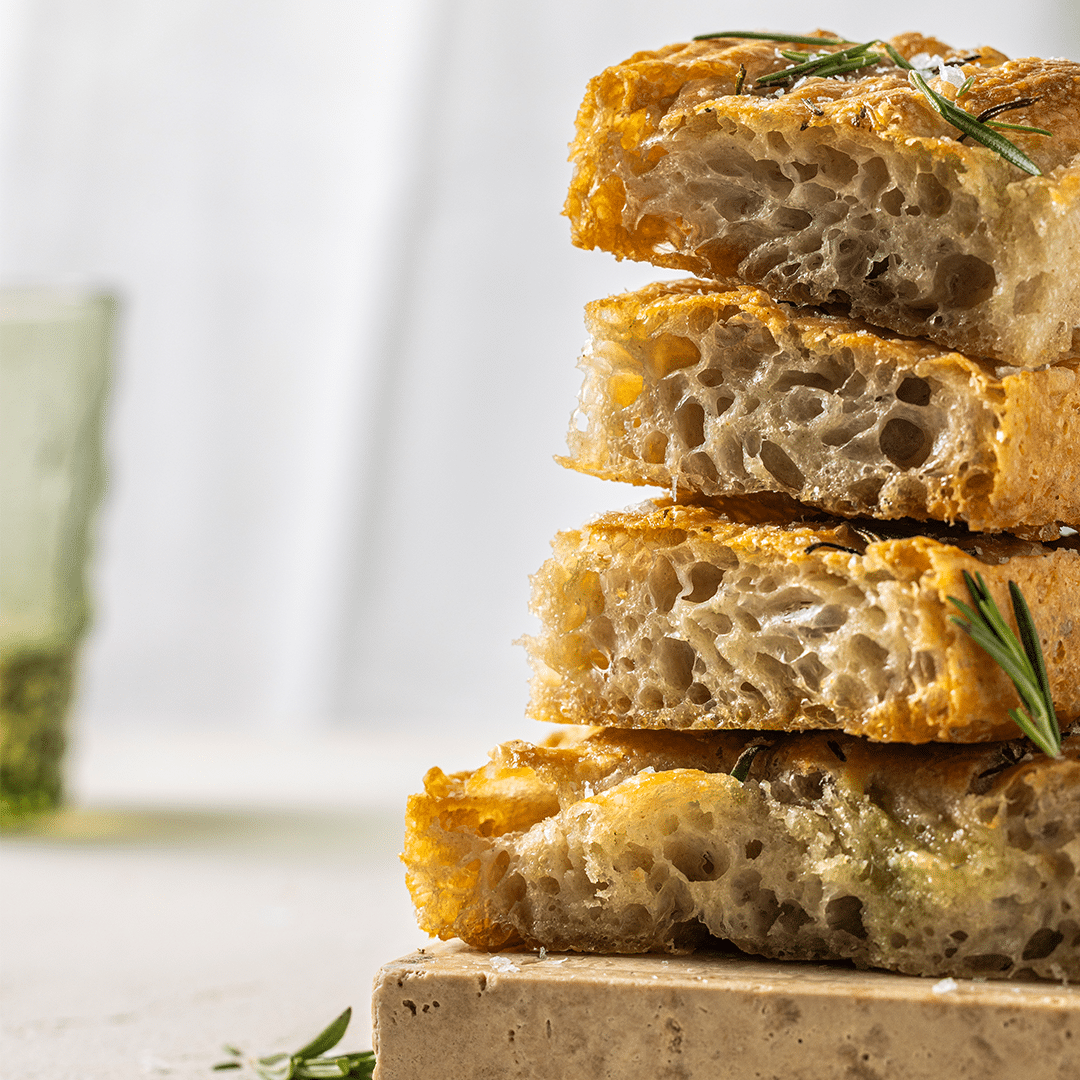
We’ve used the slow-ferment method, but the same recipe can be used for same-day baking when the craving hits hard and fast.
Classic rosemary focaccia
Makes 1 (20x28cm) loaf
Ingredients
2½ cups (375g) white bread flour + extra for dusting
½ Tbsp (7ml) fine salt
1 Tbsp (15ml) sugar
1 sachet (10g) instant yeast
1½ cups (375ml) lukewarm water
About ¼ cup (60ml) olive oil, for greasing and drizzling
Salt flakes or ground salt
Method
- Combine flour, fine salt, sugar and yeast in a stand mixer bowl.
- Slowly stream in lukewarm water while the paddle is running, until a dough forms. Knead on a medium speed for 10 minutes.
- Shape into a rectangle and place the dough in an oiled deep, large dish. Drizzle the top with oil and cover the dish with cling wrap.
- Set the dough aside in a warm spot (out of direct sunlight) and allow to rise or proof for 1 hour.
- Oil your hands and fold two long sides of dough over to the middle, overlapping the centre.
- Cover and set aside for another 30-45 minutes, until well puffed. Oil your hands and fold the top and bottom side in to toward the centre. Repeat the process one more time, finishing with a last fold of two long sides.
- Cover and chill in the fridge for 18-36 hours to slow-ferment in the cool temperature of the fridge. (The longer the dough ferments, the better the structure will be, with more bubbles inside.)
- Remove the dough at least 3 hours before baking to allow it to come up to room temperature. (This can take longer, depending on the ambient temperature. Baking the cold dough can mean it won’t rise in the oven.)
- Gently transfer dough into a lined, well-oiled 20x28cm tray.
- Spread it out using your fingers. Sprinkle with rosemary and salt flakes, then drizzle generously with olive oil.
- Allow dough to rest for 15-30 minutes. Preheat oven to 250°C.
- Using your fingers, dimple the dough all over, to trap all the topping flavours inside. Bake for 5 minutes, then reduce the temperature to 220°C and bake for another 15-20 minutes, or until golden and crisp.
- Leave to cool in the tray for 5 minutes before turning out and slicing.
Slow ferment vs same-day bread
During fermentation, the instant yeast interacts with bacteria, which forms carbon dioxide to make the dough rise. By placing the dough in the fridge for at least 18 hours or up to 3 days, the temperature drops and leavening is slowed down. This is done to improve the texture and flavour. Although bread can be baked on the same day, the result will be more dense with a distinct flavour. To use this method, let dough proof for 1½ hours before each of the three folds.
Recipe & styling: Liezl Vermeulen
Photography: Zhann Solomon
Also read: Pull-apart pizza bread