Free-range chicken producer Noorsveld Chickens caught our eye with their extra-large, yellow-hued chicken – and a price point that caused a double-take. Liezl Vermeulen finds out if there’s something to crow about.
Free-range chicken has become a status symbol in South Africa. If there’s an industrial chicken in your shopping basket in 2026, it likely isn’t because you haven’t seen a heart-wrenching video of intense factory farming in action. Rather, the current economic climate and the threat of rising inflation can force free-range poultry out of reach, no matter how virtuous your intentions.
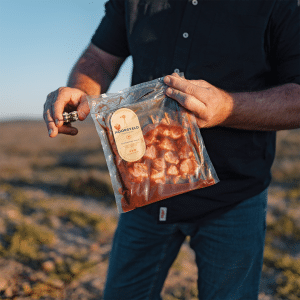
In April 2026, Noorsveld Chickens was selling a whole bird for R78/kg in a Western Cape Spar. This was R21 less than a free-range competitor and R1 cheaper than the house-brand chicken on the same shelf (R79 for non-free-range). It seems like Noorsveld is carving out a new section in shops: attainable free-range.
https://vt.tiktok.com/ZSQ5qctJr/
Fowl Play
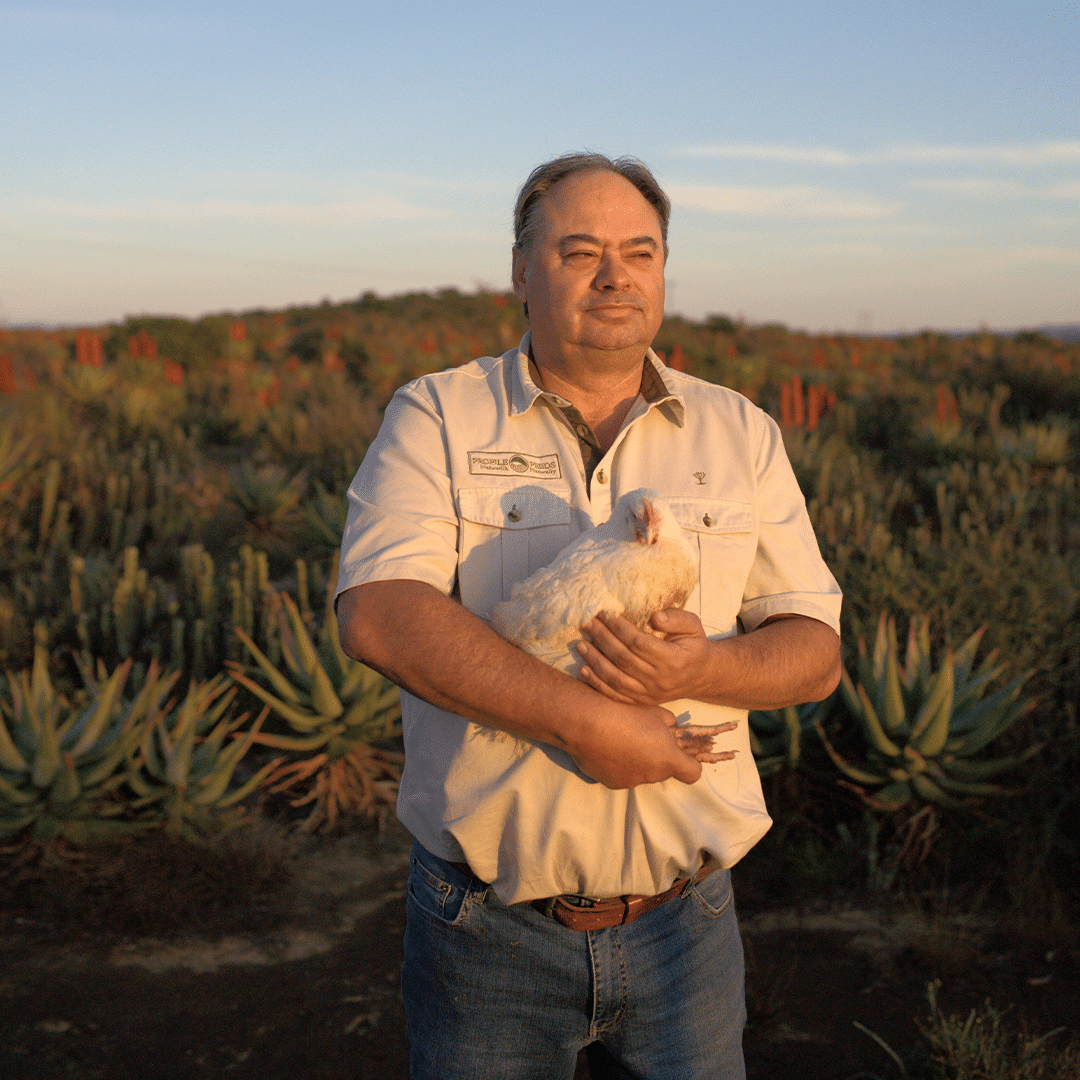
“You won’t believe how chickens play,” says Gerrit Dos Santos, owner of Noorsveld Chickens. “They’re like little children, tackling each other and running around.” Berné Botha, the general manager, chimes in that retail clients have occasionally raised concerns about seeing a scratch mark on the chicken’s skin because they don’t understand that free-range chickens play and fight.
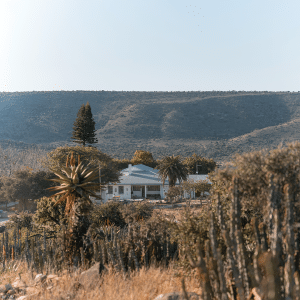
Gerrit inherited his farm from his grandmother. Located in the tiny town of Jansenville (an hour outside Robert Sobukwe, previously Graaff-Reinet) in the Karoo Heartland, it had only a few sheep and goats – nothing to make it economically viable. After the bank denied him his ostrich-farm dreams, he bought 300 chickens in 1991 and set out on his new journey. He started by selling chickens to a few homes in town. “The ones with a lot of kids ordered up to 10 chickens a month.”
He tried doing his own little shop so that people could come to him instead of the other way around, but it brought its own set of problems that took him away from his farm too much.
Today, his booming bird business has more than 200 permanent employees (making it the biggest permanent employer in the town), and three of his children have joined the team, which doesn’t come as a surprise once you witness his zeal for chicken farming. Now the farm supplies free-range chicken to most of the major retailers in the Eastern Cape, and in the past two years, they’ve branched out to stock several retailers and restaurants in the Western Cape.

Going Slow to Grow
“People are production driven. We wouldn’t have made it against them; everything was working against us,” explains Gerrit, adding that their location – being far away from the market and producers of feed – was not ideal. “We had to look at an exclusive market and I liked the way free-range farmers were doing things.”
He dives into the nitty-gritty because free-range farming is about much more than simply letting chickens go outside.
“For the time the chickens are there, you try to make them as happy as possible. The happier they are, the better they do.”
https://vt.tiktok.com/ZSQ5qYMY2/
Gerrit makes it clear that his role as a free-range farmer isn’t to badmouth anyone. He does, however, want to put what they do into perspective, and in doing so, industrial chicken farming practices do come up.
Low-level lighting during the day keeps the industrial chicken’s movement to a minimum. This is important because a chicken that is growing abnormally fast (due to antibiotics and animal protein in its diet) would likely die of a heart attack if it lived longer than the 30-33 days, that is the industry standard, simply because its body cannot keep up with the growth. He pauses and makes it clear that free-range farming still isn’t at the speed it would happen without human interference or in the wild. If they were to work at that rate, the price would more than double and production wouldn’t keep up with demand.
Fundamentals of Free Range
Berne mentions that many small farmers may say their animals are free-roaming and call them free-range, but until a farm is independently audited by a third party and gets certified, there is just no guarantee for the consumer.
Because free-range is about much more than simply having access to the outdoors. “There are several things a farmer needs to have in place to make it free-range,” explains Gerrit.
Firstly, the chickens need free-range certified feed. Noorsveld uses Profile Feeds’ food, a mix using exclusively yellow corn and soya, with the addition of some vitamins.
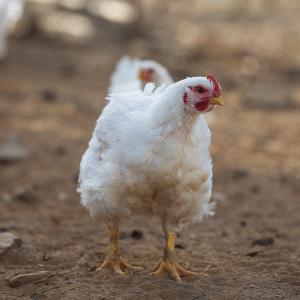
“It’s that yellow corn that gives our chicken the unique yellow colour.”
Importantly, this supplier is also audited by a third party to ensure the feed meets the criteria. This means the chickens don’t receive any antibiotics, making them a healthier choice for human consumption.
The feed contains no animal protein (in industrial farming, this could be a powder made from animal by-products).
Secondly, stocking density (the number of chickens per square meter) can only be 15.
By comparison, industrial chicken farming can have up to 22 chickens. While seven additional chickens may not sound like much, it’s important to remember the volume at which they work. If Noorsveld has 20 000 chickens, an industrial chicken farm can have over 29 000 on the same size of land.
Thirdly, their outside roaming space needs to be twice as big as their indoor space. Plus, they should always have access to the indoor space for shelter.
“That’s the ultimate proof of a free-range chicken,” says Berné, “one that doesn’t go out when it has the chance to do so.” He adds that chickens are temperamental, getting hot and cold quite easily. “We have foggers to cool them down in summer and heaters to warm them up in winter.
“I don’t even have that at home!”
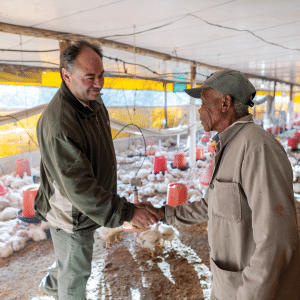
Then, they need to sleep eight hours a night and, during the day, they need continuous access to natural light outside for at least six hours a day.
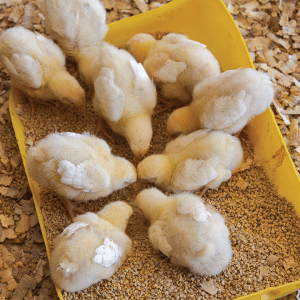
Gerrit chuckles. “Chickens are scared of the dark. The amount of sound those little chicks make. and the moment you switch the lights on, they all go quiet at once. It’s like flipping off the radio switch.”
Finally, a chicken needs freedom to express natural behaviour. That means going out to forage and play – it’s chickens simply being chickens.
It’s clear Gerrit isn’t just meeting regulations. He feels it’s the right thing to do, and he knows it delivers a better product.
Rule of the Roost
The conversation illustrates that the microbiology behind chicken farming is the biggest threat and the hardest work.
“Chickens sleep and eat in the same place they poop.” Naturally, this means there’s a lot of bacteria that require expert management to keep birds healthy.
Dry conditions prevent breeding of bacteria, and the team reckons the arid Karoo counts greatly in their favour. “This climate of extremes makes for naturally healthier chickens.”
Other steps to keep the livestock healthy include keeping only one age group on a farm, as chickens of different ages could carry different bacteria. And this isn’t a different plot of land across the road; it’s at least 10 kilometres further, as bacteria are airborne. This means the same farm worker can’t even move between two groups without risking infection.
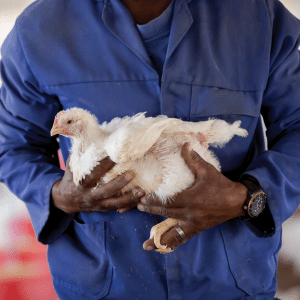
In addition, once the chickens are moved off the farm, the area is disinfected and left empty for a period of 17 days. This downtime means any bacteria will die, as it needs Berné, the one who’s on the road, driving to their stockists and managing any complaints, says people have asked what to do or add to get their chickens this big. “The only reason they can deliver a 2kg-plus bird is because they are healthy.” Because the chickens aren’t fed antibiotics, they aren’t growing at a speed the body and intestines cannot keep up with. They can be comfortably left to live a bit longer.
More Cluck for Your Buck
“A lot of guys take advantage of free-range. Through good farming practices, we try to produce chicken in the most affordable way,” says Gerrit.
Noorsveld chickens are hand-trimmed of excess fat, plus time is taken to hand-pluck feathers (something machines just can’t do with precision).
This means they process at a slower speed, working on 15 chickens per minute instead of 120 like their industrial competitors.
Then there are other small details consumers might miss because it isn’t stated on the packaging label – there’s just too much to mention on one sticker – like the fact that their thighs don’t include the backbone. The backbone can amount to 20-30% of the weight, which is why their price per kilo might be slightly higher, but the consumer is guaranteed more meat. Not to mention there is the fact that a mature bird has better flavour and better bone-to-meat ratio, giving you more meat.
Flying Ahead
“Our current goal is to come in at a price between industrial chicken and free-range chicken.
I want people to be able to try free-range chicken, to be able to eat it at an affordable rate.
That person might not be able to pay R40 per kilo more, but they could manage to pay R10-R15 a kilo more,” explains Berné.
But it’s not just a game of the price is right. Berné and Gerrit take regular road trips together, leaving behind the blue noors succulents in the arid Karoo for small towns and city skylines to talk directly to their stockists and get honest feedback. “Guys don’t tell you about all the small stuff they’re unhappy about, but when you see each other face to face then they give you honest feedback”, says Gerrit. “We’ve always managed to change for the better when we listen to feedback, because we take the punch and we take it seriously.”
Before they think of expanding further into the country, Noorsveld Chickens wants to ensure they have things under control in the Western Cape, where they’ve just started working in the past two years. They aren’t in a rush; they want to make sure their standard is maintained. They want to improve before considering expansion.
“You’re always trying to be better, to keep on improving.”
When asked how they like to eat chicken, Gerrit and Berne say they keep it simple. Gerrit’s favourite is wings, and he says salt, pepper and lemon are all you need. Berné says you just need to focus on getting it cooked while keeping the inside juicy and the skin crisp.
“If you get that right, it really doesn’t matter what you put on it – it will be delicious.” Their keep-it-simple-and-affordable approach rings true, whether on the farm or at the table.
Words: Liezl Vermeulen
Photographs: Supplied
Text Courtesy of: My Kitchen magazine