What is it about chicken soup that mellows and mends us? Christi Nortier asked three local cooks how they make this universal soother and what it has meant in their life, kitchen and community.
Chicken pho for breakfast, lunch & dinner
Anytime you go into Yen’s Vietnamese Street Food, you’ll find a huge pot of beef bone broth puttering away on the stove. It could be just starting its 24-hour simmer, or about to be ladled into white porcelain bowls perfect for warming your hands. This is just one of the special ingredients which makes their chicken pho something Cape Townians will happily eat twice a day, five days a week.
“In Vietnam, you can’t go far without coming across a bowl of chicken pho [pronounced fuh]. Many people have chicken pho for breakfast, lunch and dinner. It’s Vietnam’s main food,” says Yen Nguyen, the force behind the restaurant, Oranjezicht City Farm Market stall and now Vietnamese mini mart.
Her love for this aromatic soup goes way back, right to childhood. “Food is massive in Vietnam —you don’t need to eat the same thing every day. In the village where I grew up, chicken pho was everywhere,” she says. “But there was one place, close to my house, that made it just the way I like it and it’s still open. Everyone makes pho differently. That’s where my pho’s flavour started and I made it my own from there.”
And she’s been perfecting it for a while. As a teenager, she cooked all three meals for herself, her mother and brother before her school day started at 12pm. The factory next to their house employed about 30 people, all of which went out each day to buy lunch. Soon, the factory owner approached Yen’s mom and asked that she make food for the staff — they could smell the incredible meals being made. So, at 16 years old, Yen started her first food business with a new daily menu made with fresh ingredients sourced from the local market. And of course, chicken pho featured.
Now, Yen adds her own flourishes. It starts with clean beef marrow bones simmering for 24 hours, topped up with water as needed. Meanwhile, whole chickens are roasted —not boiled, as per tradition, which Yen believes delivers less flavour. The bowl is warmed with boiling water before the cooked rice noodles and bean sprouts are added. Then the roasted chicken is plated along with coriander, basil, mint and spring onion with lemon on the side. Only then is the hot aromatic broth ladled over, arriving at the table piping hot.
Customers often say her pho is “fancy” compared to what they taste in Vietnam, and she says it probably is. “I like to add more texture to mine as well as lemongrass, which is very unusual. I think it gives the pho a special flavour,” she explains.
“Pho is something that can be eaten three times a day because it has all the flavour in one bowl: sour, chilli, salty, not too sweet,” explains Yen. “It’s got noodles, veggies and protein. You just see the steam, smell it and then you want a warm bowl of it to hold and eat,” she laughs. She adds that it’s also a comfort food that satiates when you’re very hungry, just peckish, feeling unwell or on top of the world.
But more than anything, you feel refreshed afterwards: “You don’t feel heavy. It’s like you can breathe more easily.”
“Food is massive in Vietnam — you don’t need to eat the same thing every day. In the village where I grew up, chicken pho was everywhere.”
Chicken & matzo balls, a joy any day of the year
Adam Klein knew he had his recipe right when the smell whipped him back two decades to his grandmother’s Sea Point apartment. “My father’s mother was a real matriarchal homemaker type of person. She was like a true Jewish mother and cook. We would often go for Friday night dinner at her place, and there was always this very familiar smell,” he recalls. “When I first started making the chicken soup, I was cooking the chicken schmaltz [rendered chicken fat and onions] and the smell literally transported me back to being eight or nine years old. It was like magic.”
Fast forward ten years and you can taste Adam’s version of his grandmother’s chicken and noodle or matzo ball soup at Kleinsky‘s Deli, started with his brother Joel in 2013. At the time, running his nightclub in Cape Town left Adam with time during the day to tinker with various hobbies: carpentry, smoking meats and making chicken schmaltz, one of the cornerstones of traditional Jewish cooking.
With all the homemade pastrami around, he needed something to put it on. So, he went down the bagel rabbit hole, too. Plus, the neighbourhood bagel shop had moved out of the suburb, so he and Joel decided to replace it with their own. And Adam still isn’t done tweaking his soup recipe…
“People have a lot of ideas about how to make it properly, but I experimented a lot and learnt a few things. Firstly, cooking the bone broth for a few hours isn’t enough. The whole chickens need to cook for at least an hour. Then we remove the cooked meat and continue to cook the bones and skin for at least another four hours so all that richness come out,” he explains. Unlike his gran, he adds garlic and thyme. But beyond that, the carrots, leeks, turnips, onions and celery are as she would have done.
But then there’s the question of matzo balls. “Growing up, the matzo balls were the thing I looked forward to most about Passover [a week-long Jewish celebration]. I would try to have as many as possible. When I started making them for the deli, I was so happy that I could have them anytime. So that’s why they’re available here all year round. I take full advantage of it — I had it for lunch yesterday,” he laughs.
“When I was planning to do this deli, I wanted to make it possible for people that have never tried traditional Jewish food like matzo balls or Rugelach to have the opportunity to taste them,” he explains. That’s why you can have chicken soup with matzo balls, noodles or even both, if you like. It’s all about sharing the pleasures of what he grew up eating. Hearing that someone tried something new, and now loves it, is a huge source of joy for him.
So, what’s in these matzo balls? Schmaltz, crushed matzo crackers, some chicken broth and egg are combined and rolled to resemble a golf ball. Then, they’re cooked in the chicken soup and swell up to almost triple the size. “They’re something that I’m quite proud of. Growing up, you would go to other people’s houses for Passover dinners and the matzo balls would be judged — there are good and bad matzo balls in this world,” he adds. “A spoon should be able to go through a good matzo ball smoothly, but a bad one either crumbles or needs too much force. A good matzo ball is a source of pride.”
Beyond being delicious, chicken soup is good for you — hence the nickname “Jewish penicillin”, Adam says. “It’s high in sodium and protein, both of which your body needs when you’re sick. It is also easy to digest and absorb nutrients from. It’s just science. I’m not a doctor, but if you’re sick then I’m sending you chicken soup. It just feels like a hug.”
The comfort of chicken & creamy corn soup
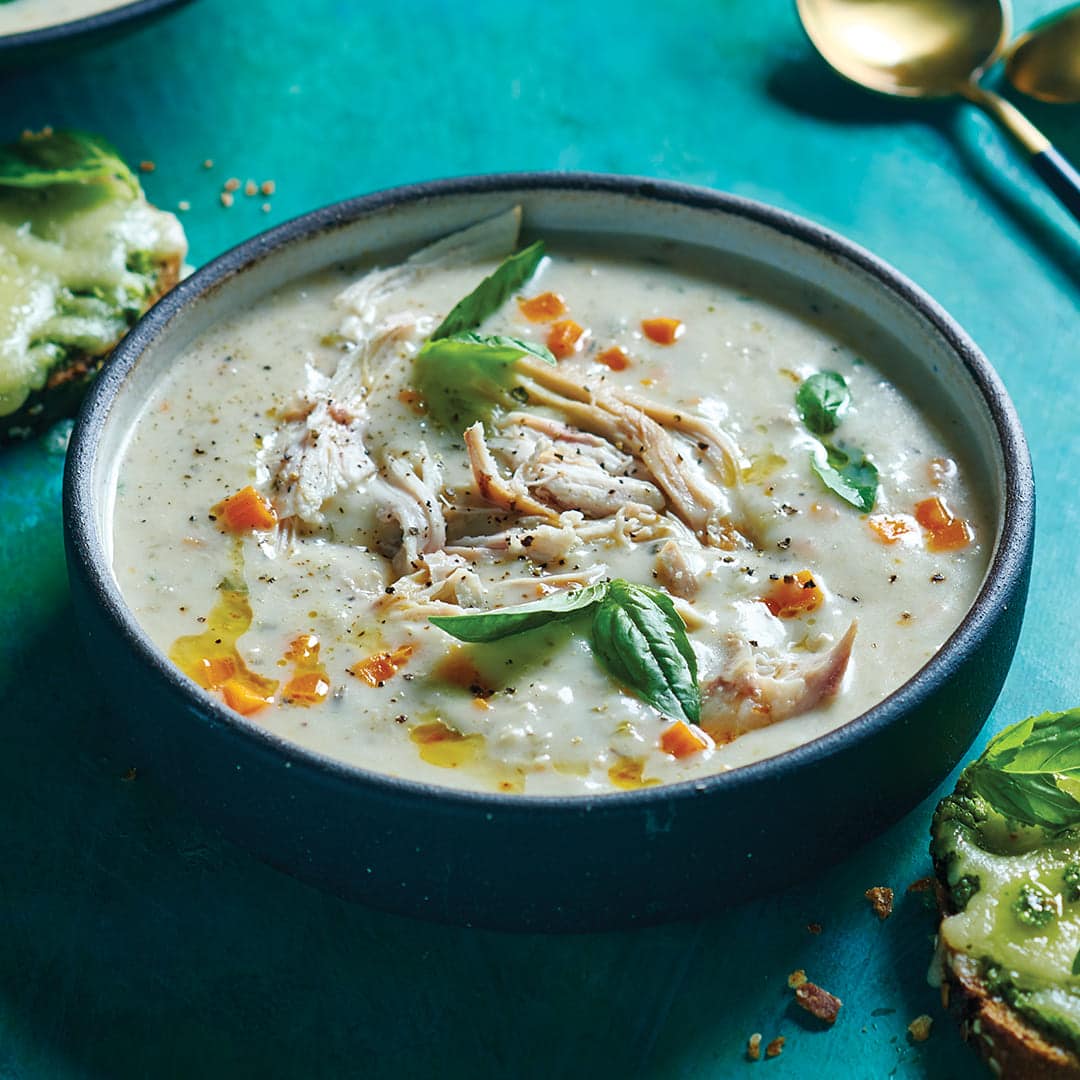
It was only a few years ago that cookbook author and presenter Gadija Sydow Noordien learnt to make the “posh soup” from her twin sister, Fatima. “We grew up eating vegetable soup, because it stretched more easily to feed six children and we grew up poor. This chicken and creamy corn soup only became popular more recently and was always seen as a treat. It’s a bit pricier because you need fresh cream, butter and chicken breasts,” she explains.
Now, she makes it as a special treat for her family come the middle of Ramadan. It’s also become popular in the wider Cape Malay community as a wedding starter — “When people see the chicken and creamy corn soup coming, it’s just smiles all round,” she laughs.
Fatima’s chicken and creamy corn soup recipe can be found in her cookbook, Cape Malay Cooking. The twins started out cooking together on social media, where loyal followers lapped up their style and cooking. Soon, a production team came knocking and their six-season cooking show Kaap, kerrie en koesisters and cookbook of the same name followed. In 2020, Fatima was diagnosed with soft-tissue sarcoma cancer. “She fought tooth and nail, but to no avail and passed on 19th December 2023. I miss her every day. She asked me before she passed to keep her legacy going,” says Gadija. And she has kept her word. She is a Spekko Rice ambassador and host of a new cooking show, Plain en Simple.
She vividly recalls the day Fatima taught her to make this soup. “I still remember we made it in her kitchen and she did everything with so much love. She sent her partner to find the purest butter, because she wanted the best texture and flavour for the corn soup,” she recalls. “He had to go out and get it, otherwise there wouldn’t be supper for that night. We had to wait for that butter! We laughed at her, but she insisted that this soup deserves the best of ingredients.”
She reminisces tasting the soup before a small sprig of thyme was thrown in and afterwards. “It made all the difference and that’s now how I make it,” she smiles. The soup has a little bit of everything, she says: creaminess, the crunch and pop of the corn, the softness of the chicken and the essential herbiness. “I just love it, especially with a crispy slice of sourdough toast. Oh jinne, ek wil dit sommer nou maak!” she laughs.
“Fatima loved that soup, especially because it is quick and easy. She loved having people at her house, and this is something hearty you can make in a flash,” she says. Like Fatima, go for the best ingredients you can afford, recommends Gadija. Explore, experiment and find the best flavour for your palate: no recipe needs to stay the same. Make it your own and pass it on to the next generation — that’s how recipes are created, after all.
“As I’m speaking about this soup, it’s raining outside,” she muses. “I think I must get my husband to fetch some ingredients!”
Also read: Gadija Sydow Noordien’s quick and easy chicken & creamy corn soup
By: Christi Nortier
Photography by: Supplied