Jane Nshuti often sat at the feet of elders —stories, cooking methods and tastes. Today she sows these seeds of knowledge into her business. Liezl Vermeulen spoke to her about African cuisine going global as well as her ancient grain recipes.
Growing up in Rwanda and the Democratic Republic of Congo, Jane Nshuti made her way to South Africa in 1999. She started to pop up on our foodie radars in 2021, when she was teaching African plant-based cooking classes. However, Jane quickly realised that she’d never be able to get the message out as far and wide as she would like to by teaching a handful of food enthusiast. So, she started to think bigger…

Thinking bigger and better
Jane sits down with us, slightly out of breath from rushing to Cape Town on a Monday morning. She’s just spent three weeks cooking and shooting her first cookbook, which she’s been writing over the course of 5 years. She’s beaming with excitement and it’s clear that this project is what she’s been waiting for. It’s launching the next phase of her work.
For this chapter, Jane partners with Livhuwani Ravele, who shuttles back and forth between the UK and SA, adding her own Venda heritage to the duo’s combined knowledge. Their company Imizi (meaning “roots” in Kinyarwanda) has set out to document indigenous African food, doing menu development for restaurants and giving immersive food tours and cooking classes.
Jane tells the story of a recent encounter with tourists who were curious about her job and excitedly asked for restaurant recommendations. She admits that it took her a while to come up with the recommendations. “And we are in Africa!” she says with frustration and disbelief. “If they asked for an Italian restaurant recommendation, I could have given them 5 names immediately”.
Jane cuts straight to the chase. Her new venture isn’t trying to produce a brick-and-mortar destination for African feasting, nor is it here to create a once-off eating experience. “It is not necessary to have an African restaurant, we can add just two dishes to the menu,” she says. After all, Jane highlights that every other restaurant has pizza on the menu (be it authentic to Italy or with a unique spin). And in the city, you’ll be hard-pressed to find a restaurant without a vegetarian section on the menu, so it’s the perfect place to subtly slot in the African food that she speaks about so passionately.
With this idea of menu development, Jane and Livhuwani have signed on their first school just outside of Cape Town, where they’ll be adding African staples to the school’s cafeteria menu.
Looking back to move ahead
Jane’s first encounter with cooking relied on story telling from her community. “It was just verbal education. We cook a lot from the heart,” says Jane. There wasn’t things that lasted, there wasn’t pen and paper to capture it”. And this means that the taste found in her grandmother’s pot is one that lives in the family’s memories.
Jane remembers when she thought about a dish her late mom made, then phoned her sister in Rwanda, asking if she recalls this dish. Her sister remembers the taste but then takes days to ask several aunties how it was made. Perhaps a week later, Jane’s sister calls back with the story of the recipe -so she wrote it down. As a mother herself, Jane wants to make sure that the next generation has this food legacy, tradition as well as the tastes, when she’s gone.
This sentiment was amplified following the passing of Livhuwani’s grandmother. The general community realised that their parents’ health is declining, their memories fading, so they all had to make an effort to capture their family’s food history before it dies with their parents and grandparents. Jane further explains that the younger generation of Africans are “pioneering a movement to start documenting what we eat for the next generation”. Like all parents, they want their children to have what they were not able to have. This is why Jane set out to capture, to teach, to share.
The African update
When asking Jane where to from here, should we be pushing African cuisine into fine-dining spaces, she quickly agrees. “Most of us have a picture of African food that is not pretty, it is not cute. If you Googled African food – I don’t even want to go there! – it’s ugly, it’s not appetising. That picture that has been created will not make it a cuisine that people are interested in.”
As a champion of ancient grains, she’s well aware of its lack of colour and dainty touches. But we agree that African food can set out to play in that arena. “We need people to know that it is not only healthy or good for the environment. We eat it (and you should eat it) because it’s good! We need to make sure that even just looking at it, you would want to eat it.”
Contribute & collaborate
“I think we still live with a scarcity mentality, where we think: ‘There’s only a small piece of the pie for me'”. Although we’re making advances in sharing what African cuisine has to offer, there are many in the food industry that have expressed a sense of gatekeeping when it comes to who gets to tell the story.
“The world we live in now, we often assume that because people are ‘connected’ to hundreds and hundreds of people [online], that they are the resource we need.” As a reality check, Jane reminds those in the room that we often get a sense of gatekeeping because we want to connect with the people who have clout. “But actually, those are not the people we need right now,” she says. Our ancestors did a poor job of documenting our cuisine and indigenous foods. We still need to be at the feet of the people who actually have the knowledge, so that when we present the food to the world, we have the right information.”
Jane wholeheartedly believes it is important to gather wisdom from a wide range of people – hot just the well-known chefs and influencers – in order to fully portray the real Africa. Instead, she dips into the knowledge of people like Siphiwe Sithole. “She has knowledge FOR DAYS! Her online following might be small, but the amount of information she can share is so big.” As a farmer, Siphiwe has a seed bank and understands how indigenous foods work. After all, knowledge-sharing is like sharing food. The more people at the table, the more conversation, the better the meal.
Who’s joining the table?
As awareness around cultural appropriation grows; we wanted to get a sense of how best to share recipes from Africa, recognising the people behind the food, especially when it’s not part of your own heritage. “My people will come for me but the chefs with a lot of clout, they’ve taken a lot of inspiration from French and Italian cooking. They’re making scones and calling them African! I get upset when someone has tried to make something African, then here we are in the comments telling them how it shouldn’t be made like that.
“How are we going to let people actually taste our food without making them feel intimidated, as if they are not allowed.” Jane argues the reason why the Italians and the French have managed to cultivate a continuously growing interest in their food is because they gave people the liberty to express themselves. “We’ve exploited the French as we’re all making French toast any which. way, using our pre-sliced bread loaves. They might say we do it differently, but they don’t attack people.”
“So, for me, I’m standing on this: Food is a form of expression,” says Jane. “Let people take what we have and then put their own twist on it without being judged.” She goes onto explain that she doesn’t want to take part in a “fight” about cultural appropriation when people are just cooking. (Moments earlier she told us how ridiculously expensive fonio is, now since the Western world has picked up on it, and that she worries about accessibility for those who eat it as a staple. This highlighted that there isn’t indifference to exploitation, there is simply an invitation for everyone to join in.)
“If we REALLY want African cuisine to thrive, we need to give people the freedom and permission. to actually cook it and to add themselves in it.” And as a parting thought, Jane shares the heart behind her cookbook that she’s just captured, beautifully summarising her spirit of cooking. This is me; this is how I express myself through cooking. Take it and add a part of you when you make it.”
Teff porridge
Serves 4
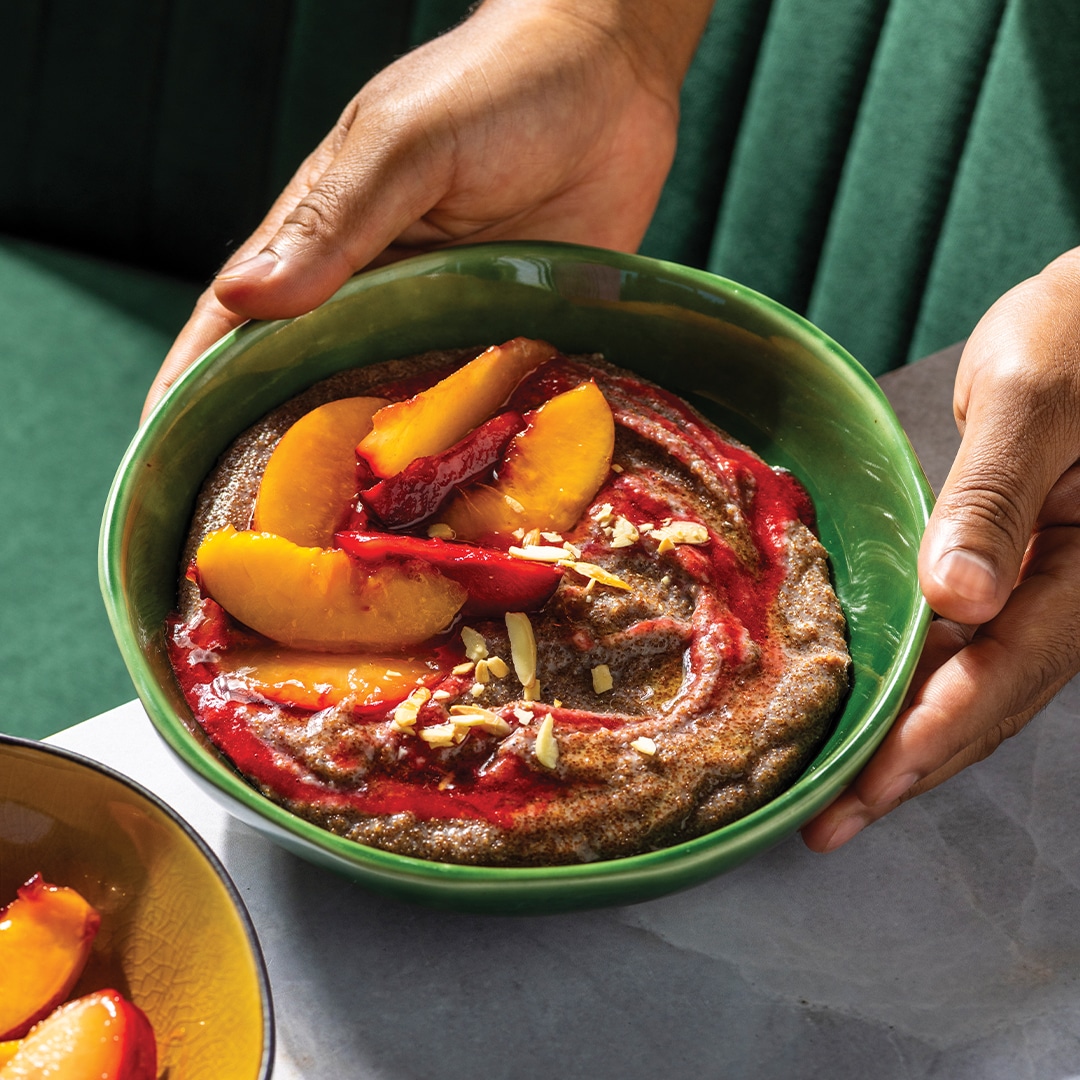
The Ethiopian gluten-free grain is a tasty and nutritious way to fuel your day.
Ingredients
1 cup whole teff seeds
2 cups water
1 cup milk of choice + extra, for serving (optional)
Salt
1-2 Tbsp maple syrup or honey
½ tsp ground cinnamon (optional)
1-2 nectarines or plums, cut into wedges
2-3 Tbsp roasted almonds and chopped nuts
Method
- Rinse the teff seeds under cold water, until water runs clear.
- Combine teff, water, milk and a pinch of salt in a pot. Bring the mixture to a boil over medium-high heat. Once boiling, reduce heat. Cover and simmer for 20-30 minutes, stirring occasionally to prevent burning, or until the grain softens to a porridge-like consistency.
- Stir in the maple syrup or honey and cinnamon. Adjust the sweetness and spice level to your liking.
- Remove the pot from heat and allow the porridge stand for about 5 minutes.
- Serve warm and garnish with fruit, nuts and extra milk.
Amarantha and mango pudding
Serves 4-6
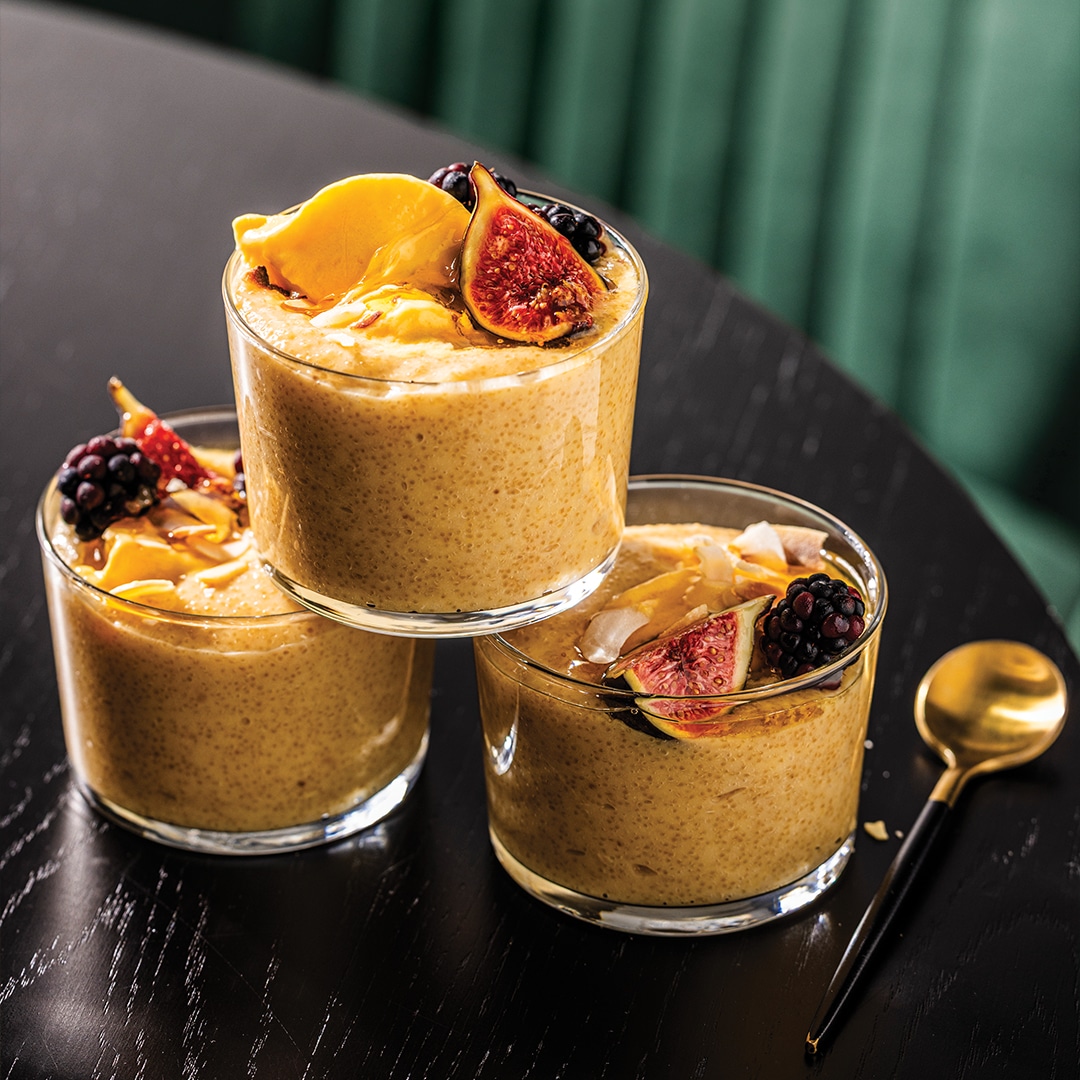
A sweet, tropical twist on a classic, where creamy amaranth meets juicy mango for a spoonful of sunshine.
Ingredients
5 cups water
1 cup amaranth
Pinch of salt
½ cup frozen mango
½ cup plain yoghurt (use plant-based yoghurt for a vegan meal)
¼ cup maple syrup or honey (use honee for a vegan meal)
Berries or seasonal fruit, for serving
Nuts and/or coconut flakes, for serving
Method
- Heat water in a pot over medium heat.
- Add amaranth and salt then cook for about 30 minutes or until all the water has evaporated, resulting in a sticky consistency.
- Once cooked, allow mixture to cool completely.
- Blend the mango, yoghurt, and maple syrup or honey until smooth.
- Combine the amaranth and mango mixture and divide into serving glasses.
- Top with berries, nuts, coconut flakes, and a drizzle of maple syrup or honey. Serve cold.
Black-eyed beans akara
Serves 4-6
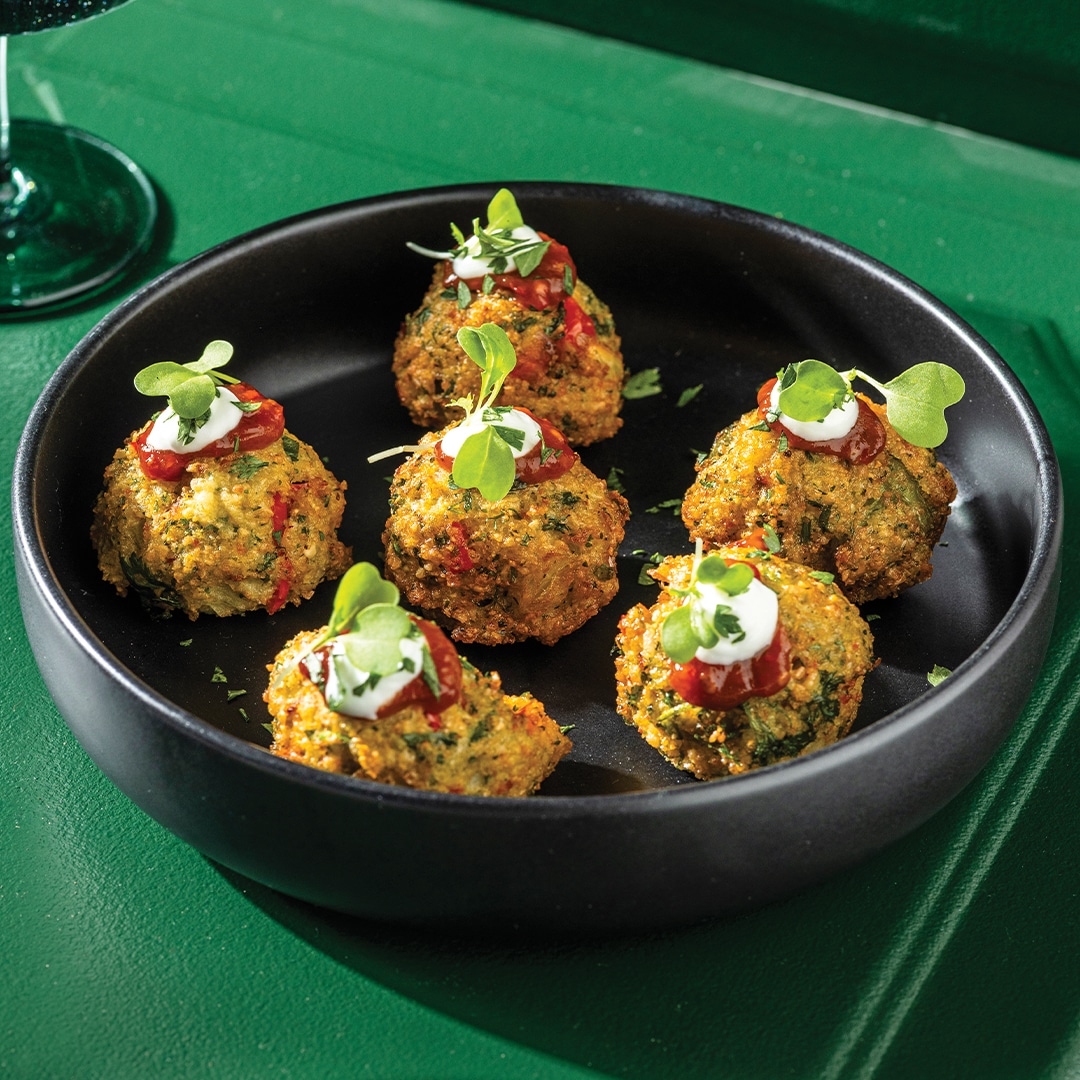
Crispy on the outside, fluffy on the inside — these black-eyed bean akara are a savoury bite of West African goodness, perfect for any time of day.
Ingredients
2 cups dry black-eyed beans or honey beans
¼ cup water, for blending
1 red and green pepper each, deseeded and chopped
1 small Habanero, Scotch bonnet or jalapeno chilli
1 medium onion, finely chopped
1 tsp onion granules or onion powder
1 tsp garlic powder
Handful coriander, chopped
Salt
Oil, for deep frying
Method
- Soak the beans in enough water to cover for about 15 to 20 minutes until the skin is swollen.
- Place the beans in the food processor with a bit of water.
- Pulse the food processor a few times to remove the skin from the beans, adding slightly more water if needed.
- Place beans into a large bowl, add enough water, and gently swirl the beans around so the skins float. Discard the skins.
- Repeat this process until the beans are clean.
- Place the clean beans into a blender, add the water, half of the red pepper, half of the green pepper, chilli, half of the onion, and the onion and garlic powder. Season, then blend until smooth.
- Place batter in a bowl and whisk until it’s light and fluffy – it may take a few minutes.
- Add the remaining peppers, onion and coriander, gently fold with a wooden spoon or spatula in one direction.
- Heat oil in a pan on medium to high heat.
- Drop a spoonful of the batter into the hot oil, frying in small batches to prevent overcrowding.
- Flip once or twice to ensure even browning. Fry until golden brown on all sides, for about 5 minutes. Remove with a slotted spoon and drain on kitchen towel. Season while warm.
- Serve with chilli sauce.
Sorghum stir fry
Serves 4-6
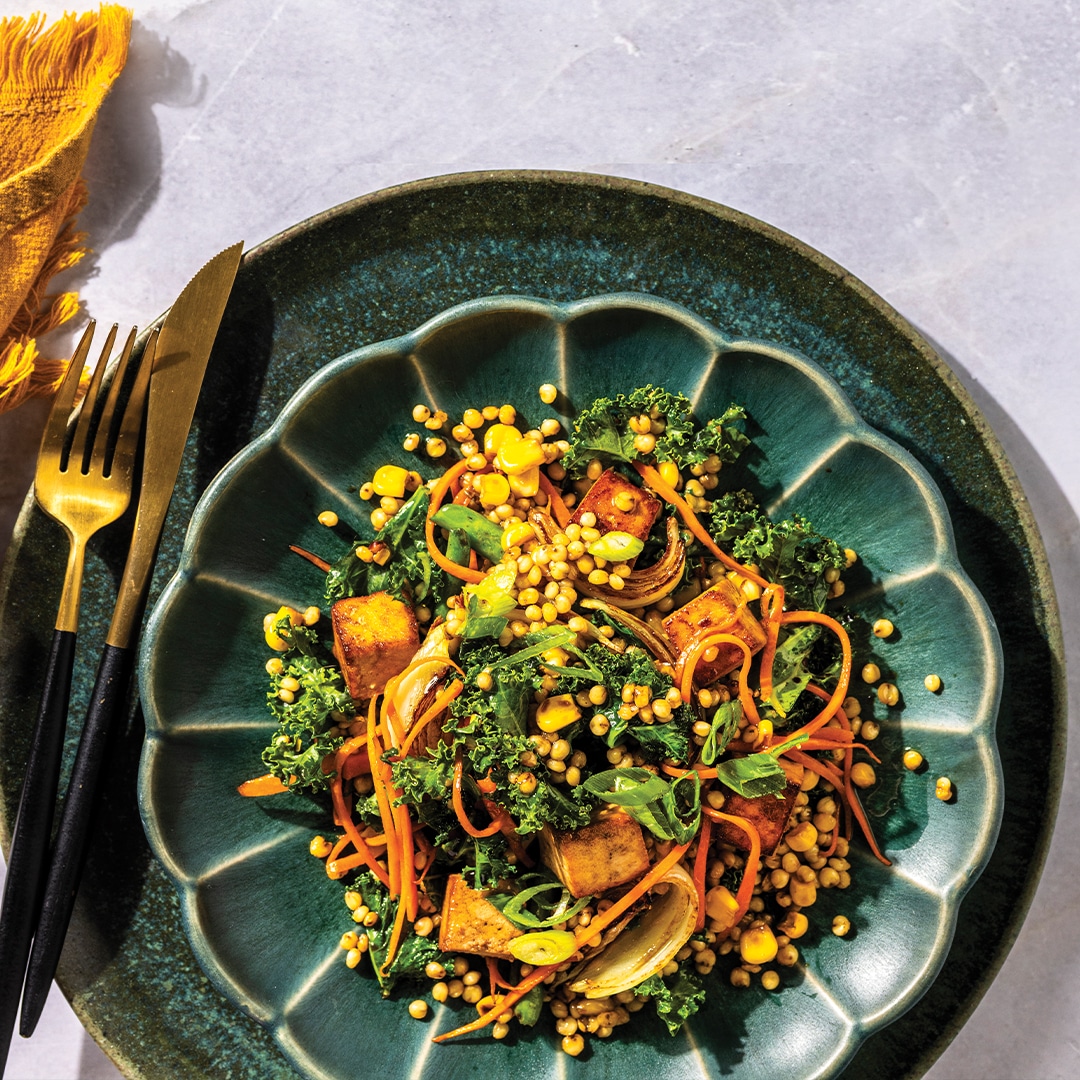
A hearty, meat-free dish that’s packed with fibre and protein, giving quinoa a run for its money. It’s the perfect base for a wholesome, plant-powered meal.
Ingredients
300g firm tofu
2 Tbsp soy sauce
4-6 tsp neutral oil (canola or sunflower works well)
1 medium onion, diced
100g green beans, sliced into 2-3cm pieces
1 carrot, thinly sliced
1 cup frozen corn
1 small clove garlic, finely grated
2 tsp grated ginger
3-4 cups cooked white sorghum
200g kale, chopped into equal pieces
2 spring onions, thinly sliced
Garlic and herb seasoning
Salt
Method
- Cut the tofu into cubes and place them in a bowl. Drizzle 1 Tbsp of soy sauce over the tofu, mix thoroughly, and let it marinate for a few minutes, occasionally spooning the soy sauce over the exposed pieces.
- Heat 2 tsp of oil in a pan over high heat.
- Pan-fry the tofu until it’s lightly charred on all sides. Remove and set aside.
- Heat a large wok until it’s almost smoking, then add about 2 tsp of oil.
- Stir-fry onions for 2 minutes, followed by the green beans, carrots, corn, garlic, and ginger for an additional 2 minutes.
- Add the sorghum and stir-fry until warm.
- Add remaining soy sauce and the fried tofu.
- Toss in kale and spring onions. Season and enjoy!
Cook’s tip: You can swap tofu for chicken, if you prefer.
Fonio & roasted vegetables
Serves 4
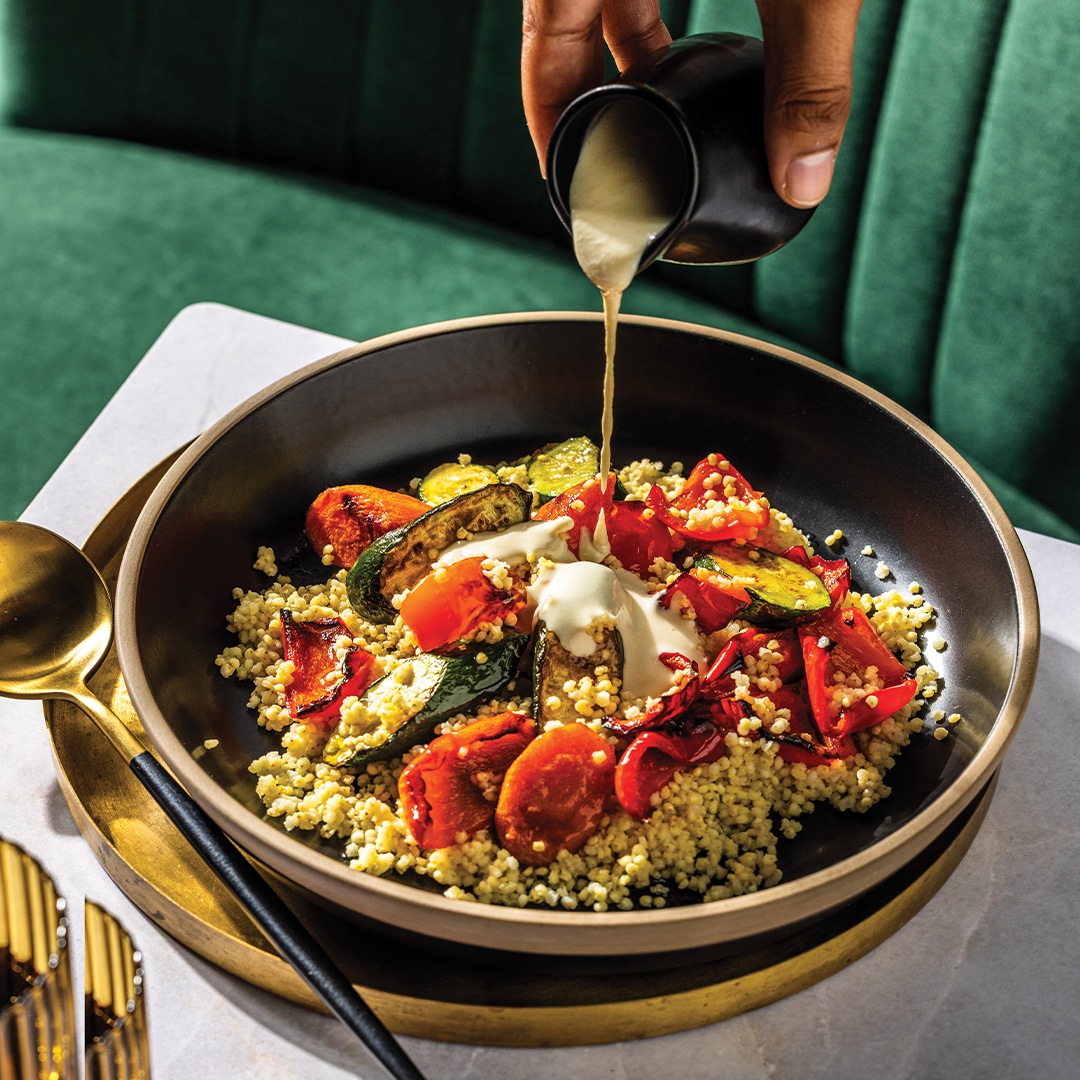
Ancient flavour with a modern twist, this dish is nutrient-dense, gluten-free and totally delicious! We made Jane’s recipe using millet as it is a great substitute and from the same grain family.
Ingredients
1 cup fonio (millet works well, too)
3 cups water
2 carrots, peeled and cut into 2cm pieces
2 baby marrows, cut into 1-2cm pieces
1 red pepper, deseeded and cut into chunks
2 Tbsp olive oil
Salt and milled pepper
For the lemon-tahini dressing
¼ cup tahini
¼ cup lemon juice
2 Tbsp water
1 small clove garlic, minced (optional)
1 Tbsp maple syrup (optional)
Salt, to taste
Method
- Preheat oven to 200°C.
- Rinse the fonio under cold water.
- In a pot, bring water to a boil with a pinch of salt.
- Add the fonio, lower heat, cover, and simmer for 15 minutes or until the water is fully absorbed.
- Fluff the cooked fonio with a fork and allow it to cool to room temperature.
- In a baking tray, drizzle the carrots, baby marrow and red pepper with olive oil. Season.
- Roast the vegetables for 20-25 minutes, or until they are tender and slightly caramelised.
- For the dressing, whisk tahini, lemon juice, water, garlic and maple syrup until smooth. Season.
- Adjust with water to reach your desired consistency.
- To assemble, combine fonio with the roasted vegetables, drizzle with dressing and toss to combine.
Cook’s tip: Serve the salad warm or at room temperature, and enjoy the bright, refreshing flavors.
By: Liezl Vermeulen
Photography by: Zhann Solomons
Text courtesy of MyKitchen magazine
Also read: Local substitutions for an African pantry