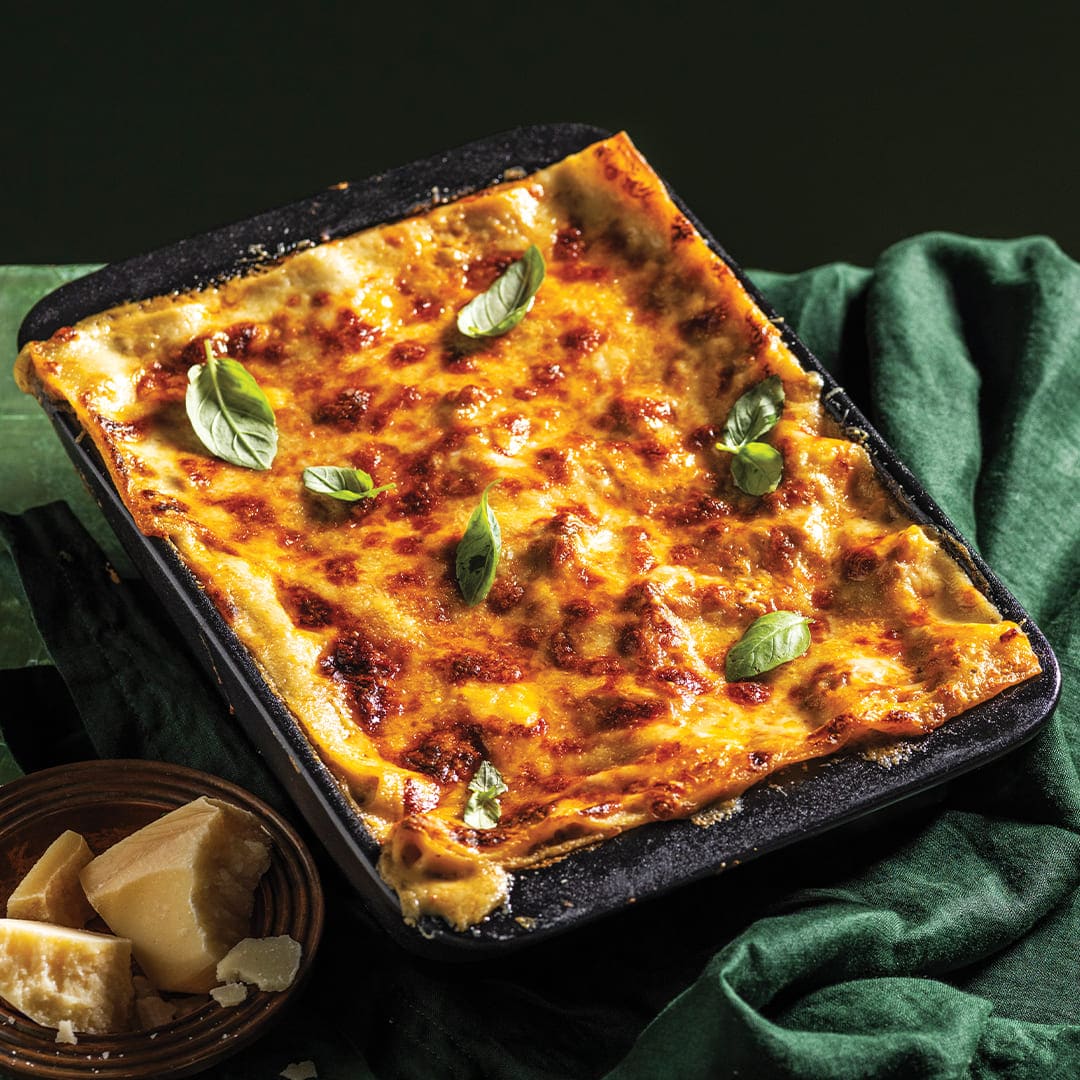
A hearty dish boasting layers of creamy béchamel sauce, tender pasta and meaty Bolognese filling: You’ll want to guard every spoonful after you taste this real-deal lasagne. Mangiamo!
Lasagne bolognese
Serves 8
Made with a mixture of slow-cooked pork and beef mince, this labour of love is all worth it when a cheesy mouthful fills your senses!
Ingredients
For the Bolognese ragu
3 Tbsp olive oil
3 Tbsp butter
100g pancetta or streaky bacon, finely chopped
1 onion, finely diced
3 cloves garlic, minced
2 carrots, finely diced
2 stalks celery, finely diced
50g tomato paste
500g lean beef mince
500g Italian pork sausage (herbed pork bangers work well too), casings removed
1 bay leaf
½ cup milk
1 cup dry white wine
1 can (400g) whole peeled tomatoes
1½ cups beef stock
Milled pepper
For the Parmesan béchamel
½ cup butter
Pinch nutmeg
2/3 cup flour
3 cups milk
1 cup vegetable stock, sieved to remove bits
2/3 cup grated Parmesan, loosely packed
250g lasagne sheets
3/4 cup grated Parmesan, loosely packed
Basil leaves
Method
- Heat oil and butter in a large pot over medium-high heat.
- Add pancetta or bacon and onion. Cook for about 5 minutes until onion is translucent and pancetta is crispy.
- Add garlic, carrots and celery. Saute for another 10 minutes until softened.
- Add tomato paste and fry for 1 minute to cook slightly.
- Add beef mince and sausage meat, stirring with a fork to separate clumps. Cook for 5 minutes until slightly browned but not caramelised.
- Add bay leaf, milk and white wine. Cover and bring to a simmer, cooking for 10 minutes to reduce liquid.
- Blitz canned tomatoes, using a stick blender, until smooth. Add to the pot along with stock and bring to a boil.
- Reduce heat to a slow simmer and cook for 90 minutes (stirring regularly and checking if there is liquid left), until thickened and rich in colour. Set aside to cool for 30 minutes.
- For the béchamel, melt butter in a large pot over medium heat. Add flour and nutmeg and whisk thoroughly until smooth.
- Add ½ cup of the stock to flour mixture while whisking. Cook until thickened. Repeat process with remaining stock and then milk, reducing heat if sauce thickens and bubbles too much.
- Once all the liquid has been incorporated, continue cooking for about 3 minutes until the sauce is smooth and has thickened to a pouring consistency.
- Remove béchamel from the heat and stir through Parmesan. Place a piece of clingfilm directly on top of the sauce and set aside.
- Preheat oven to 180°C.
- Add a generous glug of olive oil to a large plate or tray.
- Bring a large pot of salted boiling water to a boil. Cook 2-3 lasagne sheets for about 2 minutes until pliable but not completely tender. (Take care not to overcrowd the pot with pasta, or the sheets will stick together.) Remove using a slotted spoon and place onto the oiled plate or tray, coating both sides of the pasta with oil.
- Spread a spoonful of béchamel onto the base of a 27x21cm oven-proof dish. Spread 1/2-1 cup ragu over the base and top with 3 lasagne sheets. Continue to repeat layers until all ingredients are used, ending with béchamel.
- Sprinkle top of lasagne with a generous heap of grated Parmesan.
- Bake for 30 minutes until golden and bubbly on top.
- Cool lasagne for 15 minutes before dishing onto plates with basil leaves and extra Parmesan, if you like.
Did you know?
As opposed to red wine in other mince recipes, this Bolognese ragu is slow-cooked with white wine and milk to ensure the most tender meat,
The secret to the layers
About the béchamel
Traditionally, true Italian lasagne is made using a silky béchamel sauce made from only three ingredients: butter, flour and milk. Butter is melted in a pan and stirred with flour to make a paste called a ‘roux’ (pronounced ‘roo’), usually in a 1:1 ratio. Portions of milk are added in batches and stirred to slowly thicken into a beautiful sauce. In our version, we take away 1 cup of milk and substitute it for 1 cup of stock to add depth of flavour. Another non-traditional addition we included is that of cheese. A sharp and salty Parmesan finishes off the sauce beautifully! Technically, this sauce could be called a Mornay sauce (béchamel with cheese added). Other flavours sometimes included in béchamel are sliced onion and bay leaves, which are simmered along with the milk and then removed.
About the ragu bolognese
This bolognese is made the Italian way, using fewer tomatoes, a mixture of beef and pork, a splash of white wine, milk and a bay leaf. It also begins with a delicate sofrito; a mix of very finely diced onions, carrots and celery that are slowly simmered to create the perfect base flavour.
About the topping
All you need to create the best cheesy topping is a final lather of some Bolognese and béchamel (with a ratio of 2:1 part béchamel to bolognese), topped with a generous scattering of freshly grated Parmesan. For the over-the-top cheese lovers, go with a mixture of grated mozzarella and some Parmesan.
About the spelling
Lasagne is commonly spelled ‘lasagna’, especially in the US! A quick Google search will show many ‘lasagna’ recipes, with a speckling of the word ‘lasagne’. The correct spelling of this luxurious Italian dish is in fact lasagne with an ‘e’. Lasagna refers to the singular pasta sheet used in this dish, whereas lasagne is the plural form, as well as the dish in its entirety.
About the time
Making lasagne is truly a labour of love. Make it less time-intensive by cooking the béchamel 1 to 2 days beforehand. The bolognese can also be prepped and frozen for up to two months.
By: Sjaan van der Ploeg
Photography by: Zhann Solomons
Text courtesy of MyKitchen magazine